

Every year, Kyrgyzstan welcomes about 13 million tourists, but the vast majority of them visit the same places: Issyk-Kul, Ala-Archa, and the valleys around Bishkek. Dozens of villages, where production workshops operate with the support of the “One Village, One Product” (OVOP) program, are usually left off the tourist itineraries—even though it is precisely there that the items tourists later buy at the bazaar as souvenirs are made.
In recent years, OSOP’s production training programs have left the villages with not only skills but also a functioning infrastructure. For example, in the village of Mangyt, participants have mastered the production of potato chips; in sewing workshops, women’s groups sew garments according to standardized patterns and quality standards; and in the Aravan District, a whole line of rice-based products—including rice tea, body scrub, and powder—is produced. In the Jalal-Abad Region, producers are shifting from selling raw walnuts to producing nut butters and oils, while in Batken, berry processing is expanding. Each of these sites serves as a showcase where visitors can see the entire product journey: from raw materials grown just a few kilometers away to the finished, packaged product.
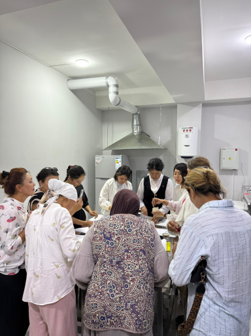
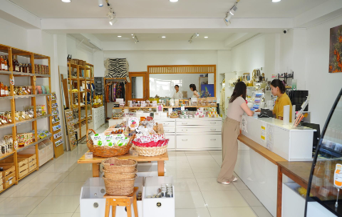
The OSOP training center and store, opened in Osh with support from RESILAND, serves as the coordinating hub for the development of production communities in the south of the country. It combines educational and retail functions, showcasing the communities’ products in a single space: here, producers learn processing technologies, certification requirements, and best practices for bringing products to market. Crucially, within this approach, products are viewed not only as commodities but also as expressions of local heritage: producers are encouraged to incorporate traditional recipes, regional stories, ethnic design elements, and artisanal craftsmanship into their branding. It is precisely this mindset that creates the conditions for a tourism destination: the cultural context, which until now had been conveyed indirectly, is presented directly to visitors through contact with the artisan, the technology, and the production site itself. In this case, the community’s intangible resources cease to be merely a tool for increasing the value of goods and become an independent source of income.
“People come not only to shop, but also to see how products are made, to taste them, and to participate in the process,” says Aigerim Umarbayeva, OSOP coordinator for the Osh region. “This creates a more holistic regional offering in which products, culture, and visitor experiences complement one another.”
Interest in such visits arises where conventional formats no longer satisfy. A store presents the end result without the process, while a tour offers the process without participation. In both cases, the tourist remains an observer and takes home an item about whose origin they know nothing. A visit to a rural workshop removes this limitation: production is shown on a scale that is easy to understand, and the visitor becomes actively involved, learning about local techniques. To this list, we should add the accompanying elements of a stay in the countryside—the landscape, the host family’s way of life, and local cuisine—which help create a unique experience.
Economically, such a visit differs from a typical sale: its cost is determined by the content of the experience, not by the cost of raw materials, and the revenue remains entirely within the community, bypassing intermediaries and transportation costs. This represents additional income within an existing production system. Equally significant is the social profile of those who earn this income. Women and young people make up the majority of the program’s participants, and the format of hosting guests allows activities to be organized where they live and combined with household responsibilities, eliminating the need for labor migration to cities or abroad.
An additional advantage is that the impact on the natural environment remains low under this format: unlike mass tourism routes to popular attractions, where human impact often exceeds the area’s capacity to recover, OSOP tourism operates in the opposite way: it is tied to a workshop rather than a natural site, is located in an already developed area, and distributes visitors in small groups across dozens of villages, thereby preventing the soil and vegetation degradation typical of overcrowded routes.
Ultimately, tourism completes the logic of the OSOP approach: the original idea behind the Japanese model was not only to increase sales but also to change how the community perceives its own resources. In this case, the product ceases to be the sole source of value; instead, the area itself—along with its people, knowledge, and culture—becomes the source of value.
To learn about unique examples, useful recommendations, and expert advice on the OSOP approach, subscribe to the OSOP Kyrgyzstan YouTube channel and read the blog of
the Japan International Cooperation Agency (JICA).
To learn more about other topics and the results of the RESILAND CA+ program—a flagship initiative of the World Bank that supports government afforestation programs—visit the CAREC website.
You can join our expert community by scanning the QR code:
This material was prepared by CAREC intern Alyona Shlyonskaya
© 2026 Regional Environmental Center for Central Asia (CAREC). Reproduction, copying, or other use of materials is permitted only with an active hyperlink to the original source. This material was prepared with informational and analytical support from AI tools.
#RESILANDCA #WorldBankGroup #RESILANDKyrgyzstan #OneVillageOneProduct #CAREC #CentralAsia