

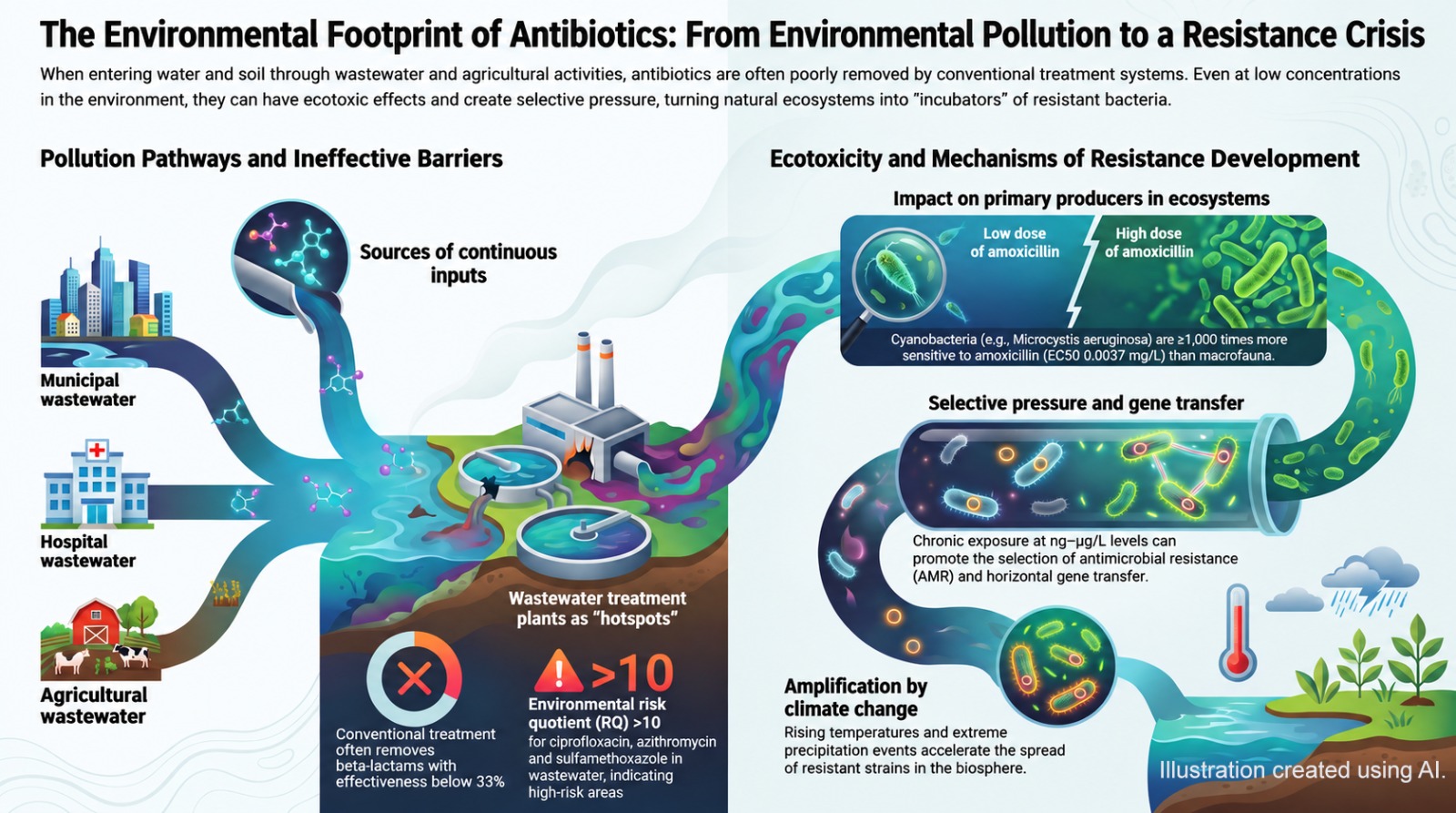
Antibiotics are essential for combating dangerous infections and saving millions of lives each year. However, following use, a portion of these pharmaceuticals enters the environment, where they can persist, affect living organisms, and facilitate the proliferation of treatment-resistant bacteria. This challenge extends beyond public health, impacting the integrity of water resources, soils, and entire ecosystems.
How Do Antibiotics Enter the Environment?
Following human or veterinary use, significant portions of active pharmaceutical ingredients and their metabolites are excreted, entering wastewater streams or animal manure. Additional pollution pathways include discharges from pharmaceutical manufacturing facilities, clinical medical waste, and agricultural run-off.
Conventional wastewater treatment plants are not always designed to fully eliminate pharmaceutical residues or antimicrobial-resistant microorganisms. Consequently, antibiotics reach rivers, lakes, and soils, creating conditions that drive the development and dissemination of antimicrobial resistance (AMR).
According to reports by the United Nations Environment Programme (UNEP), environmental pollution serves as a critical driver in the emergence and spread of antimicrobial resistance.
Impact on Soil and Aquatic Ecosystems
The consequences of environmental antibiotic exposure extend beyond the emergence of resistant bacteria. These substances can alter natural microbial communities responsible for soil fertility, organic matter decomposition, and nutrient cycling.
For instance, a study published in 2026 in Applied and Environmental Microbiology demonstrated that exposure to five common antibiotics altered soil microbial diversity and reduced the abundance of plant-growth-promoting bacteria. At the highest test concentrations, researchers observed an increase in specific antibiotic resistance genes, reduced radish biomass, and impaired plant nitrogen uptake.
In aquatic ecosystems, antibiotic residues impact microorganisms—including cyanobacteria—that are vital for oxygen production and biogeochemical cycles. Even sub-lethal concentrations, when sustained over extended exposure periods, can significantly disrupt ecosystem functioning.
The Connection to Antimicrobial Resistance
Antimicrobial resistance emerges when microorganisms adapt to survive exposure to medications designed to eradicate them.
When released into the natural environment, antibiotics exert selective pressure: susceptible bacterial populations are suppressed, while resistant strains gain a distinct competitive advantage. Furthermore, bacteria can readily exchange genetic material, including mobile resistance genes, through horizontal gene transfer.
Contaminated wastewater and soils thus act as active reservoirs for resistant microorganisms. While this does not imply that any contact with natural water or soil causes immediate clinical infection, it establishes environmental transmission pathways linking ecosystems, animal populations, and human communities.
Why This Issue Is Critical for Central Asia
For Central Asia, where water resources, irrigated agriculture, and pastoral livelihoods are deeply interdependent, the environmental dimensions of AMR warrant urgent attention.
Practices surrounding treated wastewater reuse for irrigation, livestock manure management, and municipal/industrial wastewater effluent standards directly dictate pollutant dispersion across transboundary basins.
Simultaneously, systematic surveillance data on environmental concentrations of antibiotics and resistance genes across regional soil and aquatic ecosystems remain sparse. Expanding environmental monitoring systems is essential to accurately gauge the scale of the challenge and target interventions effectively.
What Steps Must Be Taken?
Mitigating the environmental risks of AMR demands coordinated, cross-sectoral action across human health, veterinary medicine, agriculture, environmental protection agencies, and industrial sectors.
Core interventions include:
- Rational stewardship of antimicrobials across clinical and veterinary practice;
- Upgrading municipal and industrial wastewater treatment infrastructure;
- Safe management and disposal of clinical and livestock waste;
- Regulatory oversight of pharmaceutical manufacturing discharges;
- Systematic environmental surveillance of resistant pathogens and resistance determinants.
In 2024, the World Health Organization published targeted guidance on wastewater and solid waste management for antibiotic manufacturing, emphasizing source-directed pollution prevention.
The environment is not merely a passive recipient of contamination; it is an active driver in the transmission cycle of antimicrobial resistance. Addressing AMR must transcend healthcare and veterinary facilities to encompass the active protection of water systems, soils, and natural habitats.
This holistic framework underpins the One Health approach, which bridges human, animal, and environmental health. For Central Asia, operationalizing intersectoral collaboration along these lines represents a critical step toward curbing ecological risks and safeguarding population health.
What CAREC Is Doing in This Area
The Regional Environmental Centre for Central Asia (CAREC), serving as the Regional One Health program Secretariat, treats environmental contamination from antibiotics as one of its key areas of work. CAREC not only disseminates scientific evidence and raises public awareness but also advances regional cooperation through the platform of the Regional One Health Coordination Council (ROHCC), helping Central Asian countries integrate environmental dimensions of antimicrobial resistance into their National Action Plans. In the area of livestock and food systems, CAREC supports research and policy dialogue that identifies systemic gaps—such as non-prescription sales, farmer misconceptions, and drug residues in food products—and promotes a shift toward a preventive approach based on vaccination and improved animal husbandry conditions. At the same time, through regional conferences and training events, CAREC strengthens intersectoral dialogue among health, veterinary, environmental protection, and agriculture sectors, advancing concrete action on environmental monitoring, wastewater treatment, and rational antimicrobial use.
Oxana Kravtsova
One Health Program Coordinator, Regional Environmental Centre for Central Asia (CAREC)