Background
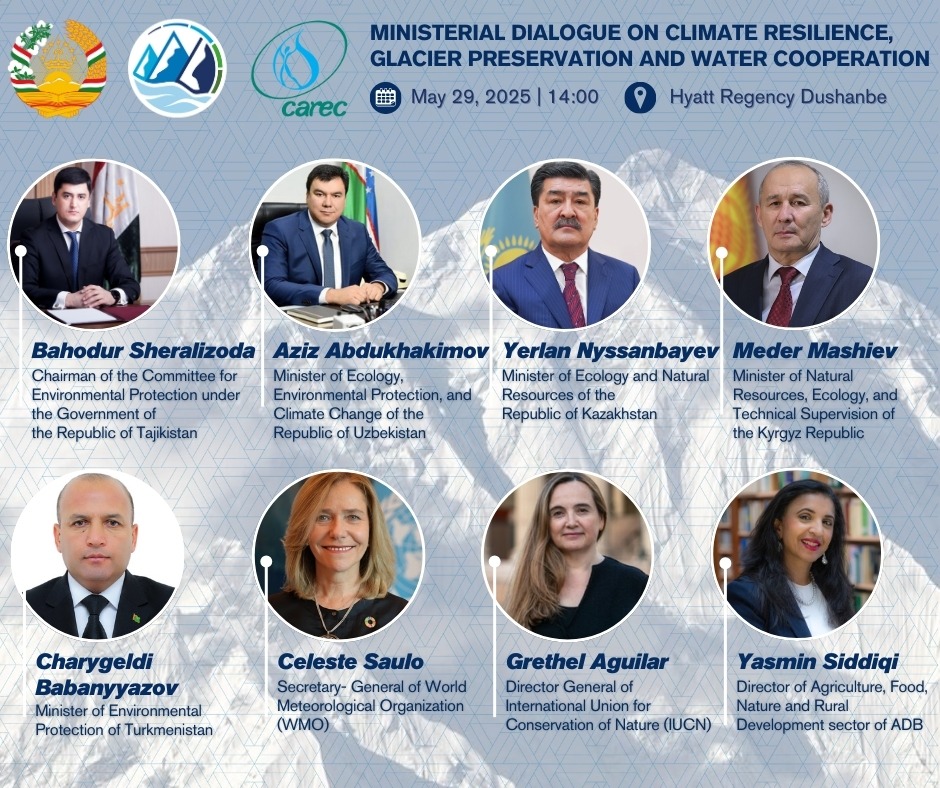
High-Level International Conference on Glaciers' Preservation will be held from 29 to 31 May 2025 in Dushanbe, Republic of Tajikistan, to highlight the vital role of glaciers in maintaining global ecological balance and addressing water-related challenges.
This Conference will emphasize the crucial connection between glaciers and sustainable socio-economic development, focusing on how glacier preservation is essential to safeguarding livelihoods, ensuring water availability, minimizing related hazards, recognizing the role of indigenous peoples and knowledge, and achieving long-term development goals for vulnerable regions and populations.
The melting of glaciers is one of the most pressing environmental challenges of our time. Climate change has already caused the loss about one-third of mountain ice, and without serious mitigation efforts, this trend will continue. As glaciers shrink, they disrupt local and seasonal water supplies that billions of people depend on for drinking water, irrigation, and energy production. This directly impacts agricultural productivity, leading to food insecurity, especially in regions where glacier-fed rivers are vital for irrigation. Additionally, the decline in glacier-fed water flows threatens hydropower generation, which many countries depend on for energy security and economic development.
The Hindu Kush Himalayan Assessment predicts that the region could lose up to two-thirds of its glaciers by the end of the century. In Tajikistan, approximately 30% of glaciers have disappeared over the last century. The Vanch Yakh (formerly Fedchenko) Glacier, the world’s largest continental glacier, has retreated by over 1 km in the past 70–80 years, shrinking by 44 km². Similar trends are observed in other regions. The Amazon River, fed by Andean glaciers, is experiencing severe drought, while rapid snowmelt, glacier outburst floods, and landslides have impacted countries from Germany to Peru to Nepal.
The melting of polar glaciers and ice sheets in the Arctic and Antarctica is also accelerating. Rapid ice loss is contributing to raising global sea levels, posing severe risks to small island developing states and coastal populations, where hundreds of millions of people live.
Recognizing the urgency of these climate challenges and their profound socio-economic implications in December 2022, the United Nations General Assembly declared 2025 as the International Year of Glaciers’ Preservation. The United Nations Educational, Scientific and Cultural Organization (UNESCO) and World Meteorological Organization (WMO) have been designated to co-facilitate related activities. In August 2024, the UN also adopted a resolution for a Decade of Action for Cryospheric Sciences, 2025–2034 to address glacier melt and cryosphere challenges through scientific research and monitoring. Furthermore, the Pact for the Future, adopted at the Summit of the Future on September 22, 2024, provides a framework for glacier preservation. These initiatives aim to address glacier melt through scientific research, resource mobilization and strengthening cooperation at all levels.
Glacier preservation is crucial for climate stability, resilience, and sustainability. This event will raise awareness and advocate for urgent collective action.
The High-Level International Conference on Glaciers’ Preservation aims to reinforce the global agenda on glaciers and the urgent need to halt their melting, calving and retreating. It will foster collaborative action, scientific innovation, and policy alignment to address glaciers melt and its widespread consequences.
The Conference will support the implementation of UN resolutions on the “International Year of Glaciers’ Preservation 2025” and the “Decade of Action for Cryospheric Sciences, 2025–2034”, by mobilizing resources and fostering international cooperation. It seeks to strengthen global partnerships among governments, scientists, civil society, and other stakeholders, with a focus on enhancing transboundary collaboration to preserve glaciers and their socio-economic benefits.
CONCEPT NOTE of the HIGH - LEVEL INTERNATIONAL CONFERENCE ON GLACIERS’ PRESERVATION
Goals
The High-Level International Conference on Glaciers’ Preservation aims to highlight the importance of glaciers and the urgency of halting their melting, calving and retreat on the Global Agenda. It seeks to advance global efforts in addressing glacier melt and its wide-ranging impacts through collaborative action, scientific innovation, and policy alignment.
The Conference will support the implementation of UN resolutions on the “International Year of Glaciers’ Preservation 2025” and the “Decade of Action for Cryosphere Sciences, 2025–2034”, by mobilizing resources and fostering international cooperation. It aims to strengthen global partnerships among governments, scientists, civil society, and other stakeholders, with a focus on enhancing transboundary collaboration to preserve glaciers and their socio-economic benefits.
Key objectives of the High-Level International Conference on Glaciers’ Preservation include:
- Advancing scientific research and monitoring to better understand glacier dynamics;
- Mitigating the socio-economic consequences of glacier retreat, and
- Promoting integrated adaptation strategies such as early warning systems and disaster risk reduction.
By linking water and climate agendas, the Conference aims to align glacier preservation efforts with global goals for water, energy, and food security. It will also raise awareness, mobilize resources, and leverage key frameworks such as the “Pact for the Future” to inspire transformative actions that ensure the resilience and sustainability of glacier-dependent communities and ecosystems.
- Key Focus Areas:Promoting scientific research and monitoring. Advancing glacier and high mountain cryosphere science including Indigenous knowledge, technological innovations, and monitoring systems. These efforts will enhance understanding of glacier retreat dynamics and their impacts on ecosystems, water resources, and the global climate system.
- Addressing socio-economic impacts of glacier melting. Examining the downstream socio-economic consequences of glacier retreat, including its effects on water availability, food security, hydropower, cultural heritage and sea-level rise. The conference will explore actionable solutions to mitigate these impacts and enhance the resilience of glacier-dependent communities.
- Enhancing climate resilience and adaptation strategies. Promoting integrated approaches for adaptation and mitigation, including early warning systems, disaster risk reduction, and infrastructure solutions to manage water resources and prevent glacial hazards. The Conference will prioritize strategies that enhance community resilience, especially in vulnerable regions.
- Raising awareness and mobilizing resources. Increasing global awareness of the vital role of glaciers preservation in ecological balance and socio-economic stability. The Conference will seek to mobilize financial and technical resources for glaciers preservation initiatives and facilitate the dissemination of best practices and transformative climate solutions.
- Linking water, biodiversity, desertification and climate agendas for sustainable development. Highlighting the interconnection between water and climate agendas, while exploring opportunities to integrate glaciers preservation into broader efforts to address global water availibility, energy, and food security challenges. The Conference will promote the alignment of glaciers preservation initiatives with long-term development goals.
- Catalyzing actions through key frameworks and partnerships. Leveragaging key global frameworks, such as the “Pact for the Future”, and strengthen partnerships and promote transformative actions in glaciers preservation. This includes creating pathways for collective action to mitigate the effects of glacier melt on global ecosystems and human well-being
Dates and venue
The High-Level International Conference on Glaciers’ Preservation will take place from May 29 to 31, 2025, in Dushanbe. The opening ceremony will be held on Friday, May 30, 2025, at 09:00 at the “Kokhi Somon” Complex, located at 122, Rudaki Ave., Dushanbe.
The venues of the pre-conference events, including forums and side-events, will be determined at a later stage. Details will be included in the official program and published on the Conference website: www.dushanbeicgp2025.com.
Access to the “Kokhi Somon” Complex and pre-conference event venues will be restricted to participants with conference badges.
Participation
The High-Level International Conference on Glaciers’ Preservation will adopt a multi-stakeholder approach, bringing together high-level officials and other representatives from UN Member States, UN entities, international organizations, financial institutions, the private sector, academia, civil society, local governments, and communities.