

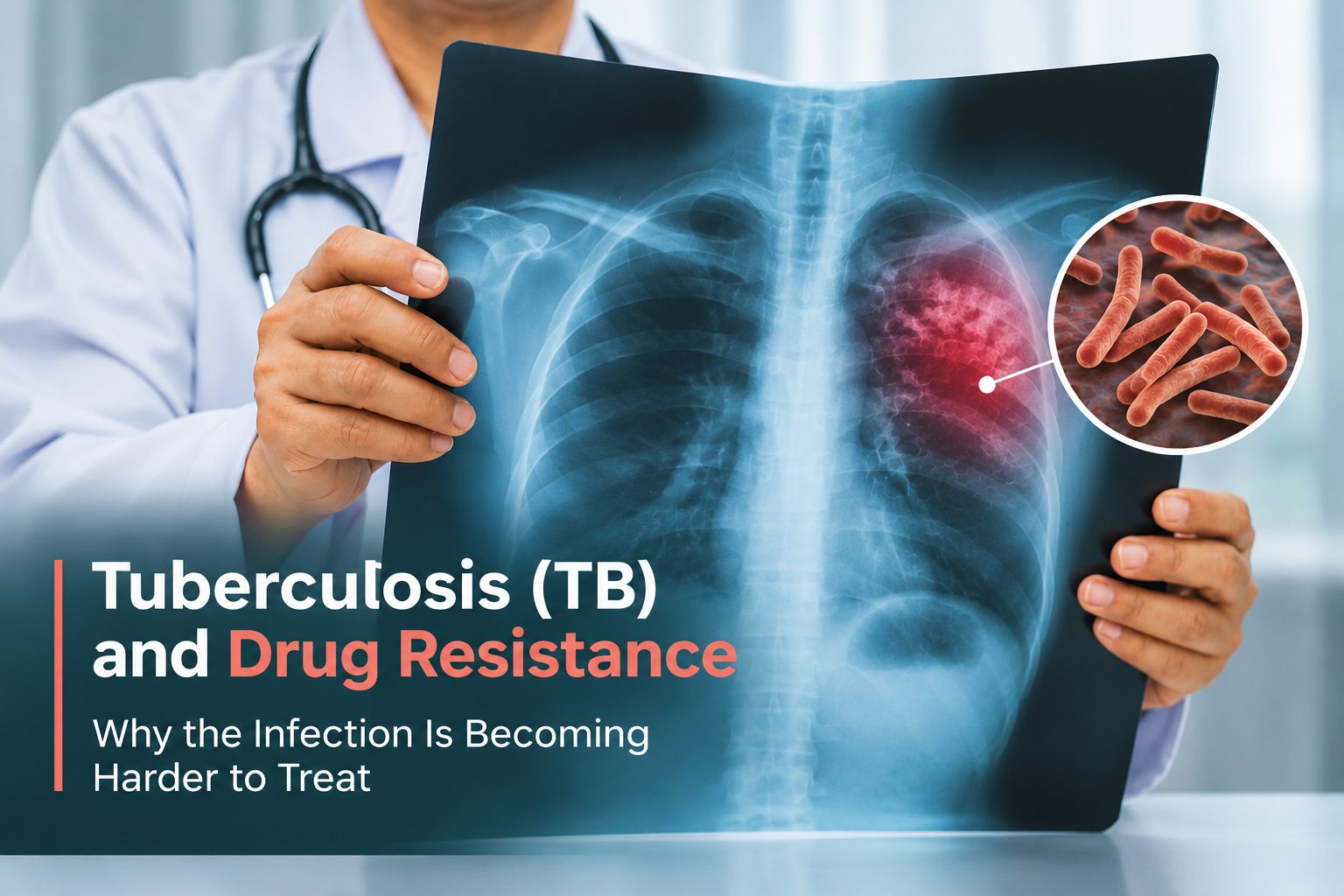
Tuberculosis (TB) remains one of the major threats to public health. It is also a clear example of antimicrobial resistance (AMR): bacteria belonging to the Mycobacterium tuberculosis complex, which cause the disease, can develop resistance to anti-TB medicines. As a result, treatment becomes more complicated.
Resistance to rifampicin, one of the key medicines used to treat tuberculosis, is a particular concern. When bacteria are resistant to both rifampicin and isoniazid, the condition is classified as multidrug-resistant tuberculosis (MDR-TB). These forms of the disease are more difficult to treat, requiring patients to take different medicines and undergo longer treatment regimens.
An even more severe form is extensively drug-resistant tuberculosis (XDR-TB). According to the WHO definition, this is a form of MDR-TB in which bacteria are additionally resistant to any fluoroquinolone and at least one of the key Group A medicines, such as bedaquiline or linezolid. In such cases, the choice of effective medicines becomes extremely limited, and the risks to the patient's life increase significantly.
The scale of the problem
According to the World Health Organization (WHO), approximately 10.6 million people worldwide developed tuberculosis in 2025. Around 370,000 of them developed rifampicin-resistant tuberculosis (RR-TB). Approximately 140,000 people died from this form of the disease.
Rifampicin resistance was detected in 3.1% of people newly diagnosed with tuberculosis and in 15% of patients who had previously received treatment.
The problem also remains acute in Central Asia. According to estimates presented by the WHO Regional Office for Europe in April 2025, more than 35,000 cases of tuberculosis were registered annually across the five countries of the region, including approximately 8,000 cases of drug-resistant TB.
Why do bacteria become resistant?
The WHO identifies two main causes. The first is ineffective or interrupted treatment. If a patient takes inappropriate medicines, misses doses or stops treatment prematurely, some bacteria may survive and continue multiplying. According to the WHO and the Centers for Disease Control and Prevention (CDC), failure to follow the prescribed treatment regimen is a key factor contributing to the development of acquired drug resistance, including MDR-TB and XDR-TB.
Standard tuberculosis treatment takes a long time. After feeling better following several weeks of medication, patients may stop treatment on their own, miss doses or take their medicines irregularly. Self-medication and taking antibiotics without a doctor's prescription further aggravate the situation.
As WHO experts note, under such conditions, only the most vulnerable bacteria are eliminated, while the more resilient ones survive, mutate, adapt to medicines and produce new generations of bacteria that are no longer susceptible to treatment. The risk also increases when treatment is prescribed incorrectly or when medicine supplies are interrupted.
The second cause is the transmission of already drug-resistant bacteria from one person to another. This means that people who have never had tuberculosis or taken anti-TB medicines can also become infected with drug-resistant TB.
Tuberculosis is transmitted primarily through the air. The longer it takes to detect the infection and initiate effective treatment, the longer the risk of transmission to others persists.
Diagnosis and treatment across the five Central Asian countries
According to WHO data for 2025, all five countries in the region — Kazakhstan, Kyrgyzstan, Tajikistan, Turkmenistan and Uzbekistan — ensured that at least 80% of patients with bacteriologically confirmed tuberculosis were tested for rifampicin resistance. These tests help determine which medicines will be effective against the bacteria.
WHO data also reveal differences in treatment approaches. In Kazakhstan, Kyrgyzstan and Uzbekistan, more than half of patients with RR-TB received longer treatment regimens lasting 18–20 months. In Tajikistan, at least 40% of patients received six-month, all-oral treatment regimens. Turkmenistan did not fall into either of these two groups.
Shorter treatment: a new step forward
In recent years, treatment for drug-resistant tuberculosis has become shorter. Some WHO-recommended regimens last just six months and consist entirely of oral medicines. One of them is BPaLM, which combines four medicines: bedaquiline, pretomanid, linezolid and moxifloxacin.
In 2025, 42% of patients with RR-TB worldwide received these six-month regimens. By comparison, the figures were 18% in 2024 and 3% in 2023. By the end of 2025, these regimens were being used in 106 countries.
However, shorter regimens are not suitable for everyone. Their selection depends on diagnostic results, the bacteria's resistance to specific medicines and the patient's health condition.
Central Asia joins forces
In April 2025, WHO/Europe and the five Central Asian countries launched the TB-Free Central Asia initiative. Its goal is to accelerate efforts to combat tuberculosis and bring the region closer to ending the disease by 2030.
The initiative focuses on strengthening diagnostic capacities, expanding access to modern treatment and promoting cooperation between countries. One important practical objective is to ensure that patients can continue their treatment even when moving from one country to another.
According to the WHO regional overview, the treatment success rate among patients with laboratory-confirmed RR/MDR-TB who started treatment in 2021 was 78% across the five Central Asian countries combined. For comparison, the global treatment success rate for RR-TB among patients who started treatment in 2023 reached 70%. These figures relate to different patient cohorts and reporting periods and therefore cannot be directly compared.
Why does this matter?
Drug-resistant tuberculosis is not only a challenge for hospitals and laboratories. Behind every statistic is a person who must undergo treatment that is often more complicated and prolonged than treatment for drug-susceptible TB.
The earlier the infection is detected, the sooner appropriate medicines are prescribed, and the more consistently patients follow their doctors' recommendations, the greater the chances of successful treatment and the lower the risk of transmitting drug-resistant bacteria to others. This is why the fight against tuberculosis concerns not only patients, but also their families, healthcare workers and society as a whole.
Shoira Toirova — Communications Specialist, One Health Program
This publication was prepared by the Regional Environmental Centre for Central Asia (CAREC) within the framework of the regional One Health Program in Central Asia. The Program is implemented with financial support from the World Bank and the Pandemic Fund. The author bears sole responsibility for the content of this publication. The views expressed do not necessarily reflect the official position of the World Bank or the Pandemic Fund.
For further information:
Oksana Kravtsova — Regional Manager of the One Health Program, CARECokravtsova@carececo.org