
CCICED Roundtable 2025 | Chongqing, China
April 29–30, 2025 — During global climate uncertainty, the CCICED Roundtable in Chongqing has emerged as a beacon of hope and cooperation for a greener, low-carbon future.
This year’s event, themed “Green and Low-carbon Transition for a Beautiful Chongqing,” brought together leaders and experts worldwide to explore bright ideas for ecological conservation, green productivity, and digital innovation in mega-city governance.
In his speech, the Executive Director of the Regional Environmental Centre for Central Asia (CAREC) and a Special Advisor to the Chinese Council for International Cooperation in the Field of Environment and Development (CCICED), Zafar Makhmudov, delivered a compelling message:
“Regional solidarity is key to global climate solutions… Central Asia stands ready to work closely with China and global partners to turn uncertainty into opportunity.”
Zafar Makhmudov emphasized that China's leadership, particularly its vision of a “Beautiful China” and commitment to a just, inclusive green transition, offers vital lessons for emerging economies. Echoing President Xi Jinping’s call for a Just Transition, he stressed that decarbonization must not come at the expense of social progress — it must bring new opportunities and prosperity for all.
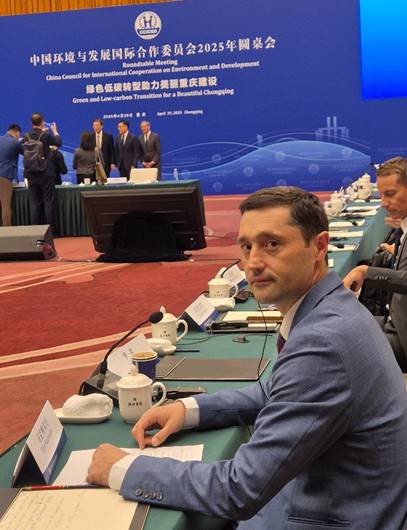
In Chongqing — China’s largest municipality and a critical ecological and industrial hub — participants explored how the principles of ecological civilization, green finance, and technology sharing can bridge the gap between ambition and action. Central Asia’s growing engagement through regional platforms such as the SCO and its participation in events like this roundtable reflects a new era of climate cooperation.
As a Special Advisor, Zafar Makhmudov proposed expanding South-South cooperation, fostering joint green technology learning platforms, and embedding ecological civilization principles into global development efforts. He reaffirmed that Central Asia is committed to contributing actively to a greener, more harmonious future—together with China and international partners.
Key themes of the Roundtable included:
- Fostering green productivity through sustainable industrial transformation.
- Strengthening the ecological barrier in the upper Yangtze River through restoration.
- Harnessing digital tools for smart, resilient urban environmental governance.
As the Roundtable will be closed with field visits and knowledge exchange, it has a clear message: climate leadership today requires collective vision, technological solidarity, and a commitment to justice — for people and the planet alike.