

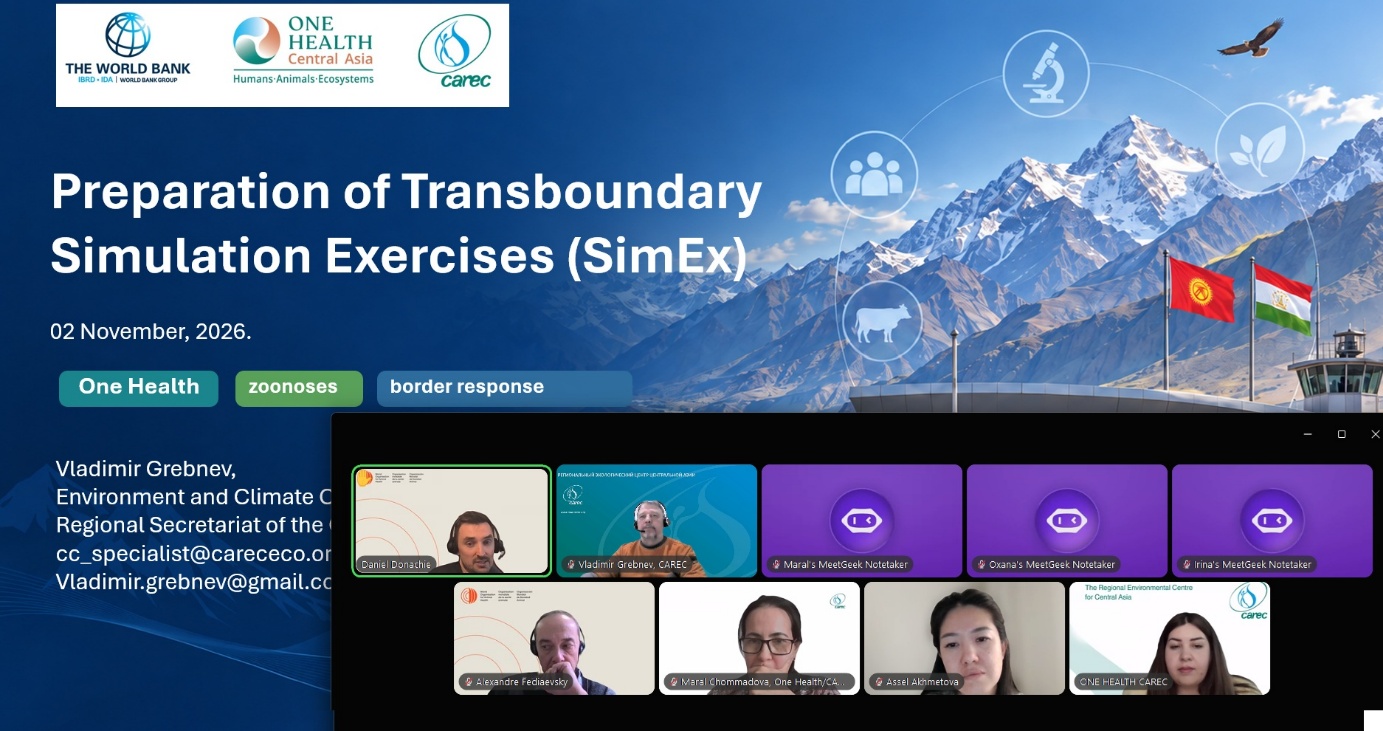
On November 2, 2026, the Regional Secretariat of the One Health Program at the Regional Environmental Centre for Central Asia held a routine working consultation with representatives of the World Organisation for Animal Health to prepare cross-border simulation exercises between the Kyrgyz Republic and the Republic of Tajikistan.
This consultation was one in a series of meetings within the already initiated preparatory process. A joint working group for organizing the exercises was established earlier, and in September 2026, at a meeting of the Regional One Health Coordination Council of the Program, the participating countries agreed on the main approaches to conducting them.
It is proposed to organize a practical module directly at a border section agreed upon by the parties, simultaneously at checkpoints on the Kyrgyz and Tajik sides. This format will allow testing the real compatibility of national procedures, notification channels, and interaction mechanisms of the two countries in the event of a threat of cross-border spread of a zoonotic infection.
During the consultation, special attention was paid to expanding the traditional approach to public health exercises through the full participation of veterinary services. It is planned to test the entire response chain: identification of a suspicious event, interagency and cross-border notification, joint epidemiological and epizootiological investigation, traceability of the movement of people, animals, and products, laboratory procedures, as well as the interaction of sanitary-quarantine, border, and customs authorities.
Participants also discussed the experience of the international Exercise Phoenix, conducted in 2023 simultaneously in countries across North Africa, the Middle East, and Southeast Asia. The exercise was organized by the Food and Agriculture Organization of the United Nations, the International Criminal Police Organization (INTERPOL), and the World Organisation for Animal Health. Veterinary services and law enforcement agencies from 12 countries took part.
Exercise Phoenix allowed testing interagency and international cooperation in responding to a simulated intentional biological threat to animal health and food security. Of particular interest for the preparation of the Kyrgyz-Tajik exercise is the experience in scenario development and injects, allocation of roles between agencies, organization of operational information exchange, and evaluation of participants' joint actions.
In preparing the cross-border exercise, it is planned to combine the methodological approaches of WHO, WOAH, and FAO with the existing national regulations, plans, and standard operating procedures of the Kyrgyz Republic and the Republic of Tajikistan. The work will be structured in accordance with the WOAH preparedness cycle, including planning, resourcing, training participants, conducting the exercise, and post-exercise analysis.
At the next stage, the working group will continue analyzing national procedures, preparing terms of reference and an agreed scenario, as well as conducting a preliminary assessment of the infrastructure and conditions for holding the practical module at the border checkpoint.
The main result of the exercise should be not only a final report, but also a specific package of improvements: an action plan for corrective measures, proposals for updating procedures, improving cross-border notification and laboratory cooperation, as well as the potential development of a joint response protocol for zoonotic threats. The Regional Secretariat provides methodological support, facilitates dialogue between participants, and consolidates preparatory materials. All operational decisions remain within the competence of the authorized state bodies of the Kyrgyz Republic and the Republic of Tajikistan.
Vladimir Grebnev, Environmental Expert, Regional Secretariat of the "One Health in Central Asia" Program, cc_specialist@carececo.org
For further information:
Oksana Kravtsova — Regional "One Health" Program Coordinator, CAREC, okravtsova@carececo.org