

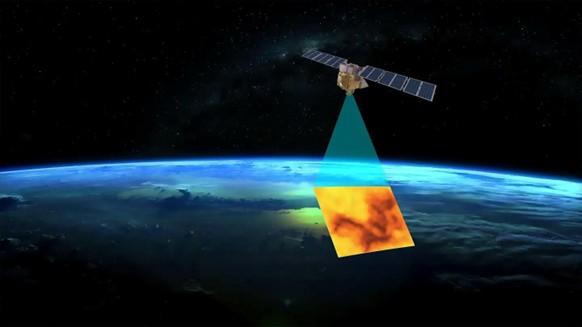
(Image credit: www.methanesat.org )
The Regional Environmental Centre for Central Asia, within the framework of the Central Asia Capacity Building for Methane Emissions Reduction (CA CBMER) project, conducted a training session dedicated to methane emissions analytics in Central Asia. The training covered satellite monitoring capabilities, international regulatory practices, and practical approaches to using data for decision-making and attracting climate finance.
The event brought together technical experts and specialists representing the Green Economy Projects Center under the Ministry of Economy and Finance of Uzbekistan (MRV Department); the Space Monitoring and Geoinformation Technologies Center under Uzcosmos; the Ecological Movement of Uzbekistan; the Research Hydrometeorological Institute; and Uzhydromet. The main speakers were project partners from the Environmental Defense Fund (EDF), a leading global non-profit environmental organization.
Participants were given a unique opportunity to explore the results of 15 months of EDF’s MethaneSAT satellite operations, which provided detailed data on methane emissions in the Amu Darya Basin in Uzbekistan. During the training, discussions focused on the need to monitor both large and small emission sources. The key role of public policy, financing, and industry initiatives in reducing emissions was highlighted, along with the importance of high-quality data and analytics for global methane mitigation efforts. The analysis of MethaneSAT data for Uzbekistan revealed significant methane emissions in the Amu Darya Basin—approximately 170 tons per hour—equivalent to economic losses estimated between USD 308 million and USD 880 million. In this regard, EDF experts noted that Uzbekistan has substantial potential to reduce emissions, which could bring both economic and reputational benefits to the country.
The training also addressed the use and integration of satellite data. In addition to MethaneSAT, other satellites are available, including commercial solutions with varying coverage areas. Developing protocols for integrating such data into the national greenhouse gas inventory remains an important task. It was noted that current efforts are focused on key production areas, while further expansion will depend on the results of the current phase and stakeholder interest.
For more information on CA CBMER activities in Uzbekistan and upcoming sessions, please contact the project team or follow updates on the project website.
Contacts:
● Dilovarsho Dustzoda – CA CBMER Project Manager (recath_manager@carececo.org)
● Arailym Shulgauova – CA CBMER Project Specialist (ashulgauova@carececo.org)