
Natalia Baidakova
Key National expert for “WasteMAP: Empowering Methane Action in Central Asia's Waste Sector” project
When climate change is discussed, carbon dioxide is usually the first greenhouse gas that comes to mind. It is widely regarded as the main driver of global warming. However, scientists are increasingly drawing attention to another greenhouse gas — methane. Although its concentration in the atmosphere is significantly lower, methane has a much stronger impact on the climate in the short term.
According to the United Nations Environment Programme (UNEP), methane is responsible for approximately one-quarter of current global warming. During the first 20 years after entering the atmosphere, methane traps heat more than 80 times more effectively than carbon dioxide. This is why reducing methane emissions is considered one of the fastest ways to slow the pace of climate change.
At the same time, public discussion has so far focused primarily on the oil and gas industry, while one of the largest anthropogenic sources of methane — municipal solid waste landfills — has received considerably less attention. Yet the waste sector has significant potential to deliver rapid emission reductions at relatively low cost.
Every day, thousands of tonnes of food waste, paper, cardboard, wood, textiles and other organic materials are sent to landfills. Once buried, these materials are deprived of oxygen. Under such conditions, anaerobic decomposition of organic matter begins, generating landfill gas.
Approximately half of landfill gas consists of methane and the other half of carbon dioxide, with small amounts of hydrogen sulfide and other compounds.
A key feature of this process is that methane generation continues for decades. Even after a landfill is closed, biochemical processes within the waste mass do not stop. As a result, old landfills can remain sources of emissions for another 20–40 years.
The problem is not limited to climate change. Methane is a highly flammable gas. Its accumulation within landfills can lead to spontaneous fires, prolonged underground fires and explosions. Such fires may continue for months, releasing toxic combustion products, fine particulate matter and carcinogenic substances into the atmosphere, posing a serious threat to public health.
Today, virtually every major international climate conference addresses methane emission reductions in the oil and gas sector. This is understandable: the industry has enormous potential to achieve rapid reductions in methane leaks. However, the waste sector has long received less attention. According to current international estimates, around 20% of global anthropogenic methane emissions come from the waste sector, with municipal solid waste landfills being the main source.
The key difference between landfills and oil and gas facilities is that in many countries there is virtually no systematic control of landfill emissions. While oil and gas companies are increasingly moving toward instrument-based measurements and implementing leak detection and repair (LDAR) programmes, most landfills continue to operate without gas collection systems or continuous monitoring.
As a result, actual emission volumes are often significantly higher than official estimates.
Another reason to pay greater attention to landfills is the high economic efficiency of mitigation measures.
Methane does not necessarily have to be released into the atmosphere. It can be captured through a network of gas wells, purified and used to generate electricity, produce heat or upgraded into biomethane. Many European cities have already turned landfill gas into an additional energy resource while simultaneously reducing greenhouse gas emissions.
Over the past several years, the international community’s approach to methane has changed dramatically.
In 2021, more than 150 countries joined the Global Methane Pledge (GMP), committing to reduce global anthropogenic methane emissions by at least 30% by 2030 compared with 2020 levels. The initiative covers three key sectors: energy, agriculture and waste.
International reports emphasize that reducing the amount of organic waste sent to landfills, introducing composting and anaerobic digestion, and developing landfill gas collection systems are among the most cost-effective climate solutions.
Just ten years ago, determining actual methane emissions was difficult. Today, the situation is changing thanks to satellite technologies.
One of the most promising tools is the WasteMAP online platform, developed with the participation of RMI, Clean Air Task Force and Global Methane Hub. The platform is designed to improve the transparency, measurability and manageability of methane emissions from the waste sector and to support countries in meeting their greenhouse gas inventory reporting commitments.
The platform combines satellite observations, national emissions inventories, EDGAR, Climate TRACE, UNFCCC and other data sources, making it possible to assess methane emissions for virtually every country and many individual landfills. It helps identify facilities with the highest emission intensities and model different emission reduction scenarios1.
For the Kyrgyz Republic, the issue of landfill methane is of particular importance.
Most of the country’s existing landfills were established decades ago and do not meet modern environmental safety requirements. They lack landfill gas collection systems, groundwater protection infrastructure and modern operating technologies.
At the same time, the amount of municipal solid waste generated is increasing, particularly in major cities. In 2025, 2,023.7 thousand tonnes of waste were transported to landfills — 1.7 times more than in 2020. More than 60% of the total volume of municipal waste collected was generated in the cities of Bishkek and Osh2.
The volume of organic waste is also increasing, and once landfilled, it becomes a source of methane emissions.
The Kyrgyz Republic is actively participating in international climate processes and continues to strengthen its commitments to reducing greenhouse gas emissions. The issue of methane, which can significantly influence the rate of global warming, is an important part of these efforts.
Kyrgyzstan views methane emission reductions as a promising area of climate policy and is paying particular attention to the waste sector, where significant amounts of methane are generated through the decomposition of organic waste in landfills.
According to the national inventory for 1990–2023, methane (CH₄) emissions accounted for approximately 29% of total greenhouse gas emissions in 2023, making methane the second most significant gas in the country’s emissions profile. Methane emissions are increasing, driven by growth in livestock numbers as well as increasing volumes of solid waste and wastewater.
In the Waste sector, methane emissions amounted to 881.85 kt CO₂-equivalent in 2023, corresponding to approximately 31,495 tonnes of CH₄ per year (using a GWP of 28), or 15.7% of the country’s total methane emissions3.
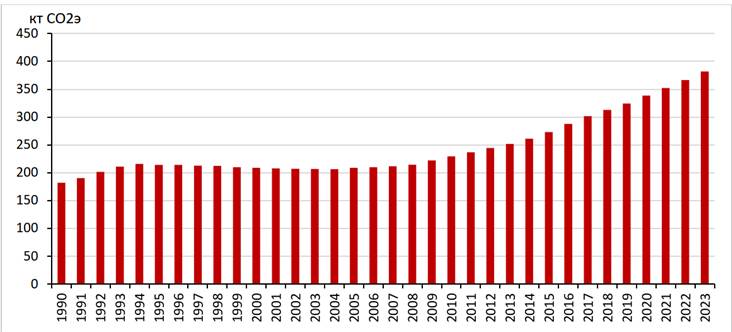
Figure 1. Dynamics of methane emissions under category 5.A.2. Unmanaged waste disposal sites
Although methane, as the second most significant greenhouse gas in the country’s overall emissions profile, accounts for approximately 29% of gross GHG emissions, its volume in CO₂-equivalent terms is already approaching the level of carbon dioxide emissions. In different years, it has reached 40–55% of CO₂ emission volumes, making Kyrgyzstan one of the few countries where methane is almost comparable to carbon dioxide as a driver of overall GHG emissions growth.
This emissions structure highlights the country’s particular vulnerability to CH₄ emissions, especially given that, unlike CO₂, methane emissions have shown a more sustained upward trend, driven primarily by agriculture and the waste management system. Without targeted methane management programmes, there is a risk that overall emissions will continue to increase even if other emission sources stabilize4.
Another challenge is the lack of reliable data. National estimates are still largely based on calculation methodologies, while instrument-based monitoring is virtually absent.
This is why international initiatives are particularly important. In 2026, the WasteMAP project was launched in Central Asia to strengthen the capacity of Kyrgyzstan and Tajikistan to assess, monitor and reduce methane emissions from the waste sector using satellite data and modern inventory methodologies.
This creates new opportunities for the preparation of national greenhouse gas inventories, mobilization of international climate finance and development of investment projects aimed at modernizing landfills.
International experience shows that the most effective approach is a comprehensive strategy.
First, the amount of organic waste sent to landfills needs to be reduced. This can be achieved through separate waste collection, composting and the recycling of food waste.
The second priority is the construction of modern landfills equipped with gas collection systems. Captured methane can be used as an energy source, making such projects attractive from both environmental and economic perspectives.
The third element is digital monitoring. The use of satellite data, unmanned technologies and modern measurement systems makes it possible to identify the most problematic facilities and assess the effectiveness of mitigation measures in a timely manner.
Strengthening national emissions accounting systems and integrating modern international platforms is also of critical importance.
Just a few years ago, landfill methane was considered primarily a municipal waste management issue. Today, it is becoming one of the key elements of global climate policy.
Reducing methane emissions from the municipal solid waste sector provides an opportunity to address climate change while simultaneously improving air quality, reducing the risk of fires, generating additional energy and modernizing waste management systems.
For Kyrgyzstan, this area is particularly valuable. As the country is currently developing a modern waste management system, there is an opportunity to incorporate leading international practices from the outset.
The country’s participation in global climate initiatives, including international efforts to reduce methane emissions, creates opportunities to strengthen the national monitoring, reporting and verification (MRV) system, improve the accuracy of emissions accounting and introduce modern emission reduction solutions. For Kyrgyzstan, this is particularly relevant given the growing volume of municipal solid waste and the need to modernize its waste management system.
Notes:
- WasteMAP — a platform for assessing methane emissions from the municipal solid waste sector.
- National Statistical Committee of the Kyrgyz Republic.
- National Inventory Document of the Kyrgyz Republic, National Report on the Inventory of Greenhouse Gas Emissions and Removals for 1990–2023.
- Nationally Determined Contribution (NDC 3.0).
**************************************************************************
The views expressed are those of the author and do not necessarily reflect the official positions of CAREC or the Global Methane Hub.
Implemented by the Regional Environmental Centre for Central Asia (CAREC) with financial support from Global Methane Hub (GMH), the “WasteMAP: Empowering Methane Action in Central Asia's Waste Sector” project focuses on strengthening national systems for monitoring and managing methane emissions in the solid waste sector through innovative digital solutions. The project will provide access to satellite data and the global WasteMAP platform.
WasteMAP is an online platform developed jointly by RMI (Rocky Mountain Institute) and CATF (the Clean Air Task Force), with support from the Global Methane Hub, aimed at ensuring transparency, measurability, and manageability of methane emissions in the waste sector.