
Kamal Kishore, Special Representative of the Secretary-General for Disaster Risk Reduction (SRSG) and Head of the United Nations Office for Disaster Risk Reduction (UNDRR), highlighted Astana as a fitting venue for advancing regional climate dialogue, noting the city’s practical efforts to address climate and disaster risks while strengthening resilience through nature-based solutions. These examples were described as inspiring and highly relevant for broader regional cooperation.
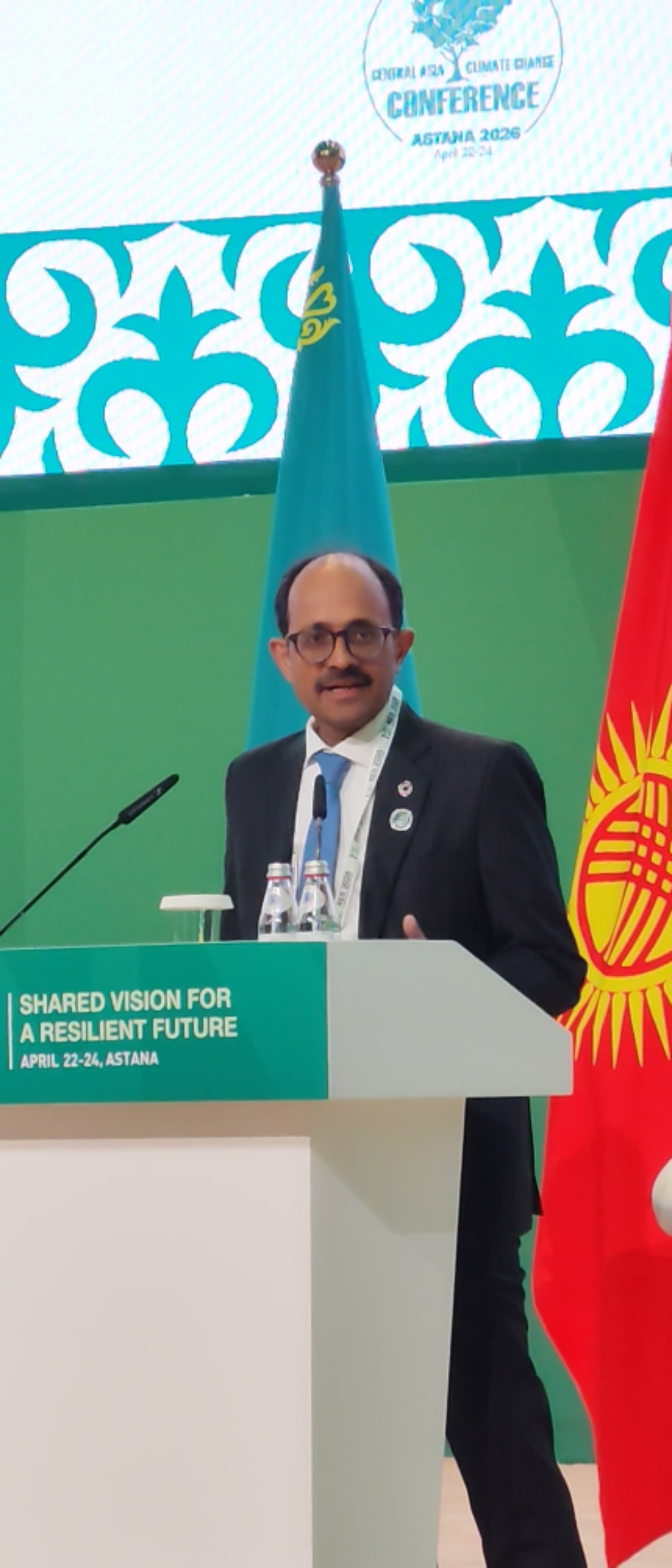
Kamal Kishore stressed that for Central Asian countries, the climate crisis is no longer a distant threat but an immediate emergency already impacting lives, livelihoods, and regional stability. He outlined a range of pressing challenges: prolonged droughts affecting agriculture, energy and water systems; extreme urban heat reducing public health and labor productivity; glacial retreat threatening long-term water availability and hydropower generation; and land degradation driving sand and dust storms.
Additionally, he pointed to growing pressure on infrastructure and public services due to climate-related displacement, underscoring the urgent need for coordinated, practical responses. Overall, the speech reinforced the importance of moving beyond commitments toward concrete implementation, supported by strong partnerships and regionally tailored solutions.
Kamal Kishore expressed appreciation to key partners, including the Regional Environmental Center for Central Asia, NDC Partnership, OSCE, World Bank, and Deutsche Gesellschaft für Internationale Zusammenarbeit, for convening the dialogue at a critical moment when countries are transitioning from updating their nationally determined contributions (NDCs) to the more challenging phase of implementation.
---------------------------------------------
CACCC-2026 is hosted by CAREC as part of the Resilient Landscapes in Central Asia (RESILAND CA+) Program of the World Bank, in cooperation with the Central Asia Water and Energy Program (CAWEP), the World Bank, and Deutsche Gesellschaft für Internationale Zusammenarbeit (GIZ) GmbH, with additional valuable support from other programs and partners.