

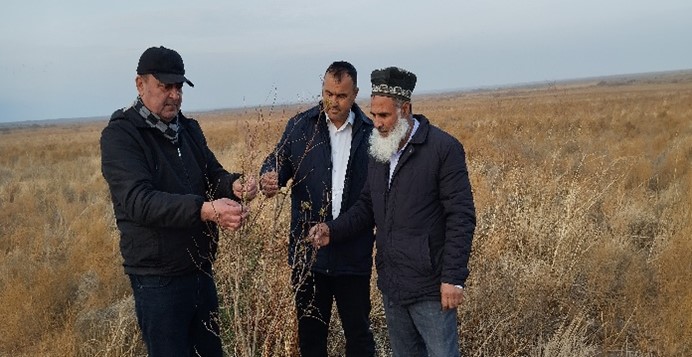
The United Nations has declared 2026 the International Year of Rangelands and Pastoralists. In this context, special attention is being given to the regional RESILAND CA+ program, which focuses on restoring degraded lands, forests, and pastures, while enhancing the resilience of rural communities to climate change.
Tajikistan is among the first countries in Central Asia to begin practical implementation of the program. This is particularly relevant for a country where about 93% of the territory is mountainous, with the remainder used for agriculture, pastures, and forests.
Solijon Mirzoev, coordinator of the RESILAND CA+ program project in Tajikistan – “Tajikistan Resilient Landscape Restoration Project” – discusses key results after a year and a half of work.
Interview in Russian
Interview Summary
- The project emphasizes a co-management model for forests and pastures with active involvement of local communities. More than 750 co-management groups and 64 pasture user groups have been established, engaging over 300,000 people. This approach empowers communities to make independent decisions on the use and restoration of natural resources, increases accountability, and improves livelihoods.
- One of the most significant achievements of the project has been the restoration and improvement of over 170,000 hectares of land, including pastures and the creation of new forest areas. For the first time since independence, Tajikistan is conducting a national forest inventory using modern advanced monitoring and scanning technologies, providing accurate data on forest conditions and enabling more effective conservation measures.
- The interview also highlights the critical role of women in natural resource management. About half of the newly formed groups are led by women, which is especially important in rural areas where women often remain the primary caretakers of land, families, and natural resources. Their participation strengthens social resilience within communities and promotes a more responsible, long-term approach to landscape management.
- The experience of implementing RESILAND CA+ in Tajikistan is considered a successful model that could be adapted in other Central Asian countries. Among the most effective project tools are co-management of forests and pastures, community engagement, restoration of forest belts, and cross-border cooperation that takes shared regional ecosystems into account.
- In conclusion, restoring sustainable landscapes is seen as a key factor in adapting to climate change, reducing the risks of droughts, dust storms, and land degradation. The RESILAND CA+ program makes a significant contribution to environmental protection, food security, and improving the quality of life for populations both in Tajikistan and across Central Asia.
By Zhanna Khusainova, Public Relations and Communications Consultant/Expert, CAREC
The Tajikistan Resilient Landscape Restoration Project is part of the World Bank’s RESILAND CA+ program, aimed at strengthening landscape resilience across Central Asian countries. Similar national and regional activities are also being implemented in Kyrgyzstan and Uzbekistan.
The Regional Environmental Centre for Central Asia (CAREC) implements the regional component of the Tajikistan Resilient Landscape Restoration Project.
Additional Information:
Solijon Mirzoev — RESILAND Tajikistan Project Manager, Center for the Implementation of Investment Projects under the Committee for Environmental Protection of the Government of the Republic of Tajikistan.
Dilovarsho Dustzoda — Deputy Team Leader of the Project Implementation Group for “Sustainable Landscape Restoration in the Republic of Tajikistan: Regional Component”, CAREC